


Project Fit & Investment Tiers
Sequoia Outdoor specializes in complete outdoor environments on the Peninsula. We do not provide minor repair services.
- Minimum Project Engagement: $25,000
- Published completed projects: $50,000 to $431,000 on this site, each shown with its scope and rounded investment
- On-Time Guarantee: Applies to all comprehensive design-build contracts.
Transforming a Peninsula estate is not merely a landscaping project. It is a civil engineering exercise wrapped in high-end finishes. In Atherton, Woodside, and Los Altos Hills, gravity and water are your biggest liabilities. The difference between a $150,000 backyard that still performs in fifteen years and one that fails in three comes down to what is buried beneath the surface. This 2026 guide reveals the true costs of proper base compaction, strict drainage engineering, and the premium hardscape required to protect your property and elevate your lifestyle.
Educational only (not legal advice). Permit triggers and inspection requirements are jurisdiction-specific. Always follow your local Authority Having Jurisdiction (AHJ).
TL;DR: Peninsula Backyard Remodel Costs (2026)
- $50k and up: One primary outdoor room zone, drainage-first planning, clean edge restraints, and foundational lighting.
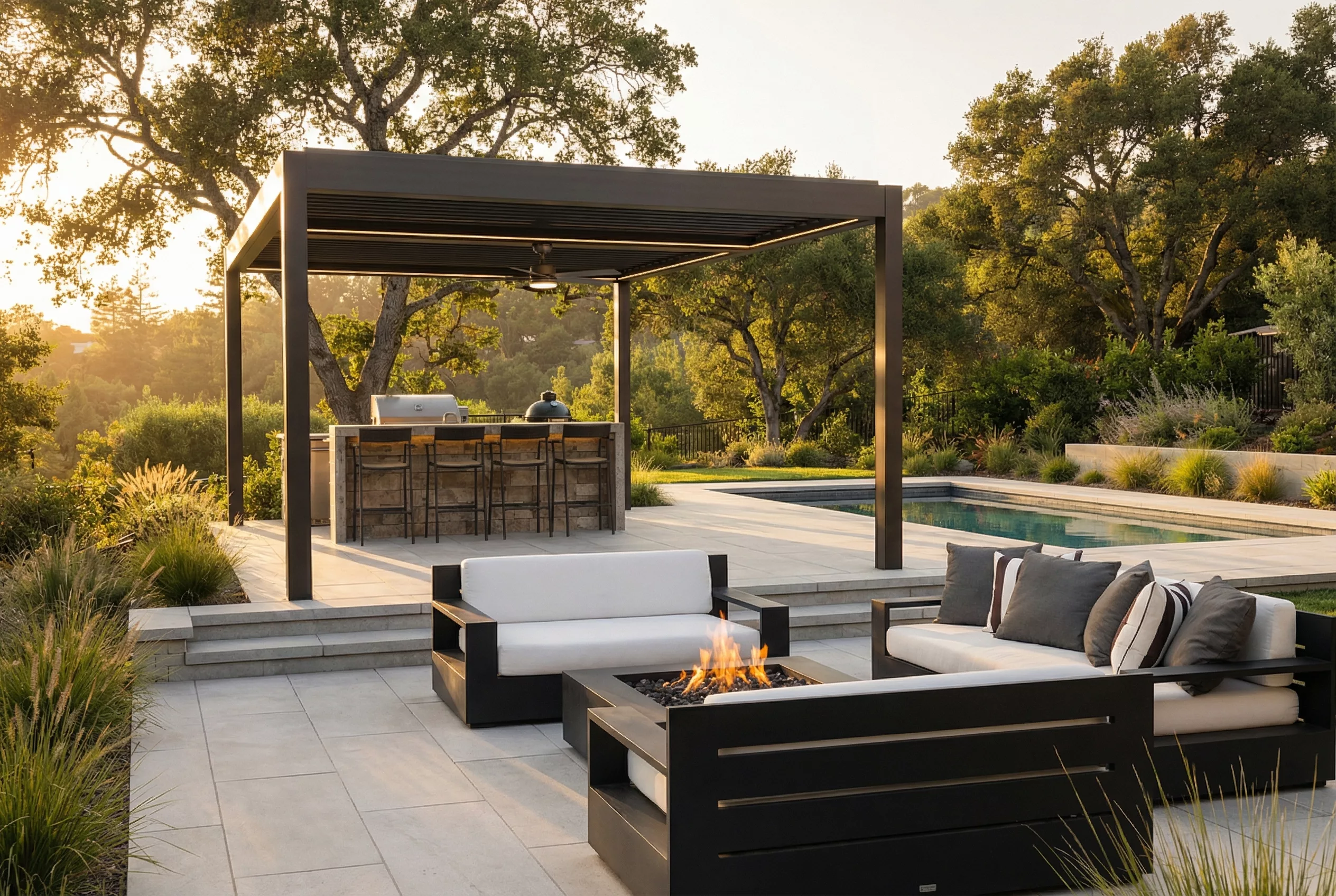
- $100k and up: Multi-zone program with structural retaining walls, whole-yard drainage systems, and often a custom outdoor kitchen or pavilion.
- $300k and up: Estate-scale footprint with heavy engineering, major grade transitions, significant utilities, and white-glove approvals coordination.
- Biggest Cost Drivers: Slopes and site access, retaining walls, drainage engineering, and utilities (gas, electrical, plumbing).
- The Most Expensive Mistake: Hiring a low-bid contractor who builds the hardscape first, then cuts it back open to fix forgotten drainage or utilities.
Costs: Peninsula Backyard Remodel Programs (2026)
In top Peninsula neighborhoods, the real budget is never just a single aesthetic feature. It is a comprehensive scoped program requiring correct subgrade preparation, coordinated utilities, durable base rock, and a finish level that reflects the luxury of the home interior.
| Program Level | Typical Investment | Core Scope Included |
|---|---|---|
| Focused Upgrade | $50k and up | One primary outdoor room zone plus drainage-first planning, clean edges, scalable lighting, and a targeted planting refresh. |
| Expanded Program | $100k and up | Multiple zones, steps or a small retaining wall, robust drainage plan, broader irrigation upgrades, and complete lighting. |
| Premium Living | $150k and up | Structural walls and grade transitions, meaningful utilities, layered lighting, custom masonry, and often an outdoor kitchen or pavilion. |
| Estate Master Plan | $300k and up | Large footprint, deep structural engineering, significant utility routing across the property, and heavy local approvals coordination. |
Cost Adders: What Pushes Projects Into the $150k and up Tier
Atherton flatlands price differently than Woodside foothills. These are the core variables that shape the final investment.
| Critical Adder | Why It Increases Cost | Where It Goes Wrong |
|---|---|---|
| Slope & Grade | Requires heavy earthmoving, soil export, and structural landings. | Underestimating water management on steep hillsides. |
| Retaining Walls | Drives strict structural engineering and permitting requirements based on height and surcharge loads. | Wall drainage and hydrostatic pressure relief left completely undefined in the bid. |
| Access Constraints | Narrow gates or street restrictions require manual material hauling rather than heavy machinery. | No staging or logistics plan, so material handling sets the schedule. |
| Utilities | Gas, electrical, and water require deep trenching and strict code compliance. | Routing not planned before hardscape is laid. |
Spec Tiers: How Premium Projects Stay Premium
You can mix aesthetic tiers, but you can never downgrade structural systems. Your base depth, drainage redundancy, and utility sizing decide how the project performs over the next decade.
| System Element | Premium Standard | The Sequoia Spec |
|---|---|---|
| Hardscape Base | Engineered base depth compacted to 95%, clean edge restraint, and consistent slope plan. | Higher load design where needed, deep subgrade correction, and refined material thresholds. |
| Drainage | Whole-yard strategy, intentional grading away from foundation, and accessible cleanouts. | Layered redundancy, strict threshold protection, and future-proof access points for maintenance. |
| Walls & Stairs | Retaining plan integrated seamlessly into layout, consistent step geometry, and safe landings. | Major structural scope, refined custom detailing, and rigorous local approvals documentation. |
Drainage & Utilities Implications
Peninsula winter storms expose weak drainage instantly. Utilities add severe complexity that becomes extremely expensive if discovered late. Our method is simple. We trench once, verify, and then build the finishes.
Pro Tip: The Trench Once Strategy
- Water: Downspouts, area drains, wall drainage, and final discharge paths are mapped before hardscape begins.
- Power: Dedicated circuits and conduit routes are planned for lighting, outdoor heaters, and future upgrades.
- Gas: Line sizing and shutoff access are calculated for fire features and cooking simultaneously.
- Service Access: Valves, cleanouts, and transformers remain easily reachable without requiring demolition.
Permits, HOAs, and Right-of-Way Realities
Permitting is heavily jurisdiction-specific. Projects run through stringent city building departments (Hillsborough, Menlo Park, Palo Alto) or the county. Furthermore, HOAs frequently add aggressive architectural review cycles.
Common 2026 permit triggers include solid roof structures (pavilions), electrical upgrades, gas extensions, retaining walls over specified heights, and any grading that alters drainage patterns per the California Building Code.
Protect Your Estate: Sequoia’s Due Diligence Advantage
The questions below are the ones worth asking any design-build contractor, including us. Ask them before a rendering is on the table, because the answers decide what the finished work is worth. Sequoia eliminates invisible risks through full CSLB compliance, documented subsurface proof, and strict financial stability.
What to Ask Any Contractor, Including Us
- Excess Liability Insurance: We carry a $5,000,000 umbrella policy above our general liability coverage, above the $2,000,000 general liability limit.
- Documented Subsurface Proof: We use a photo-documented quality checklist. Your Project Manager captures mandatory before, during, and after photos of base prep, drainage, and utilities before anything is covered.
- Live Project Tracking: We are the only contractor in Northern California that provides clients with a live project tracking portal showing real-time schedules and daily production photos.
- The On-Time Guarantee: Projects are backed by Sequoia’s written On-Time Guarantee. The completion date is set after the pre-construction walkthrough, and schedule credits apply to qualifying company-controlled delays under the published terms.
Timeline: What “Fast” Means on the Peninsula
- Design and Scope Definition: 2 to 8 weeks depending on complexity and decision speed.
- Engineering and Permits: 4 to 12+ weeks depending heavily on the specific jurisdiction and HOA cycles.
- Construction: 4 to 16+ weeks depending on walls, utilities, access, and finish level.
Schedule Reality: The project accelerates when material selections stop moving. Lock your finishes and utility routing early.
Quote Checklist: Compare Bids Without Getting Fooled
If it is not written, it is not included. This is how you avoid change-order gouging and illegal shortcuts.
| Bid Item | What to Demand | The Red Flag |
|---|---|---|
| Site Plan | Dimensioned plan showing limits of work and key elevations. | A one-page quote with no diagrams. |
| Hardscape Details | Base approach, compaction intent (95%), edge restraint, and slope targets. | Installation method left entirely undefined. |
| Drainage Plan | Where water goes in heavy rain, drain locations, cleanouts, and final discharge path. | Drainage treated as a vague allowance. |
| Permits & HOA | Clear language on who owns approvals, what is included, and what is excluded. | Homeowner responsible, with no roadmap provided. |
What to Demand in Writing
California law requires specific consumer protections for home improvement contracts. Protect your estate by demanding the following in writing:
- Scope boundaries: Exactly what is included, excluded, and assumed.
- Drainage intent: Where water goes during heavy rain, and what is being protected.
- Hardscape build method: Base approach, compaction intent, edge restraint, slope targets.
- Utility scope: Who handles trenching, conduit, shutoffs, and inspections.
- Walls and stairs: Wall type, drainage behind wall, step geometry, landings, handrails if applicable.
- Permits and HOA: Who owns the process, what is included, what triggers revisions.
- Change orders: Pricing method, approval process, schedule impact language.
- Progress payments: Payments tied strictly to completed phases, not arbitrary calendar dates.
- Warranty terms: What is covered, duration, and exactly how service is handled.
Qualifying Questions (Speeds Up Your Estimate)
- City & Neighborhood: Atherton, Hillsborough, Portola Valley, Woodside, Menlo Park, Palo Alto, Los Altos Hills, Saratoga, Monte Sereno, Los Gatos.
- Scope: Patios/hardscape, walls, steps/stairs, pergola/pavilion, outdoor kitchen, drainage, lighting, planting/irrigation.
- Timeline: Ideal start date and any hard deadlines.
- Budget Range: $50k and up.
- HOA: Yes or no, and known constraints.
Frequently Asked Questions
What is Sequoia’s minimum project size?
Our minimum engagement is $25,000. Most signed projects fall between $25,000 and $100,000; the single-zone backyard rebuilds published in our Cost Index ran $85,000 to $180,000.
Does the On-Time Guarantee apply to every project?
Our On-Time Guarantee applies to all comprehensive design-build contracts. Qualification depends on scope clarity and decision timing. We confirm eligibility during the initial consultation.
Do I need permits for a backyard remodel on the Peninsula?
Often, yes. Structures, electrical circuits, gas lines, plumbing, grading changes, and retaining walls commonly trigger permits. HOAs can add significant review steps. We plan all approvals early to protect your timeline.
When does a retaining wall become engineering and permits territory?
Wall requirements depend on height, surcharge loads, drainage behind the wall, proximity to property lines, and local jurisdiction rules. For stepped or hillside lots, walls must be engineered early in the design phase.
How long does a typical $150k project take?
Timelines depend on approvals, material selections, and site access. Projects generally include several weeks of permitting, followed by active construction. The fastest projects occur when scope and selections are locked in early.
Do you work in San Francisco?
No. We focus exclusively on the Peninsula corridor from South San Francisco down through San Jose, where project scale and logistics perfectly align with our premium design-build delivery model.
Service Area (Peninsula Focus)
We serve San Mateo and Santa Clara Counties, with a primary focus on Peninsula communities.
San Mateo County: Atherton (94027), Hillsborough (94010, 94062), Portola Valley (94028), Menlo Park (94025), San Carlos (94070), Burlingame (94010), Woodside, and Emerald Hills.
Santa Clara County: Los Altos Hills (94022, 94024), Los Altos (94022, 94024), Saratoga (95070), Monte Sereno (95030), Palo Alto (94301, 94304, 94306), Cupertino (95014), Los Gatos (95030, 95032).
Ready for a premium backyard remodel with a real schedule?
We plan the entire system: drainage, utilities, constructability, and approvals-aware scope documentation. Then we execute with live milestone visibility and a contracted completion date, set after the pre-construction walkthrough.