

Project Fit & Investment Tiers
Sequoia Outdoor specializes in complete outdoor environments on the Peninsula. We do not provide minor deck board replacements or basic overlay services.
- Minimum Project Engagement: $25,000
- Published completed projects: $50,000 to $431,000 on this site, each shown with its scope and rounded investment
- On-Time Guarantee: Applies to all comprehensive design-build contracts.
On the steep, heavily regulated hillsides of Woodside, Portola Valley, and Los Altos Hills, a deck is rarely just a few wooden planks resting on the dirt. It is a critical structural extension of your home. A failed ledger board or under-engineered caisson footing can cause thousands of dollars in water damage or lead to structural failure. This 2026 guide reveals the true costs of engineering deep concrete footings, utilizing premium composite or exotic Ipe hardwoods, and executing the strict California Building Code requirements necessary to build a permanent, multi-level entertaining space.
Educational only (not engineering advice). Every site is unique. Always verify structural requirements with a licensed civil engineer and your local Authority Having Jurisdiction (AHJ).
TL;DR: Peninsula Deck & Structure Costs (2026)
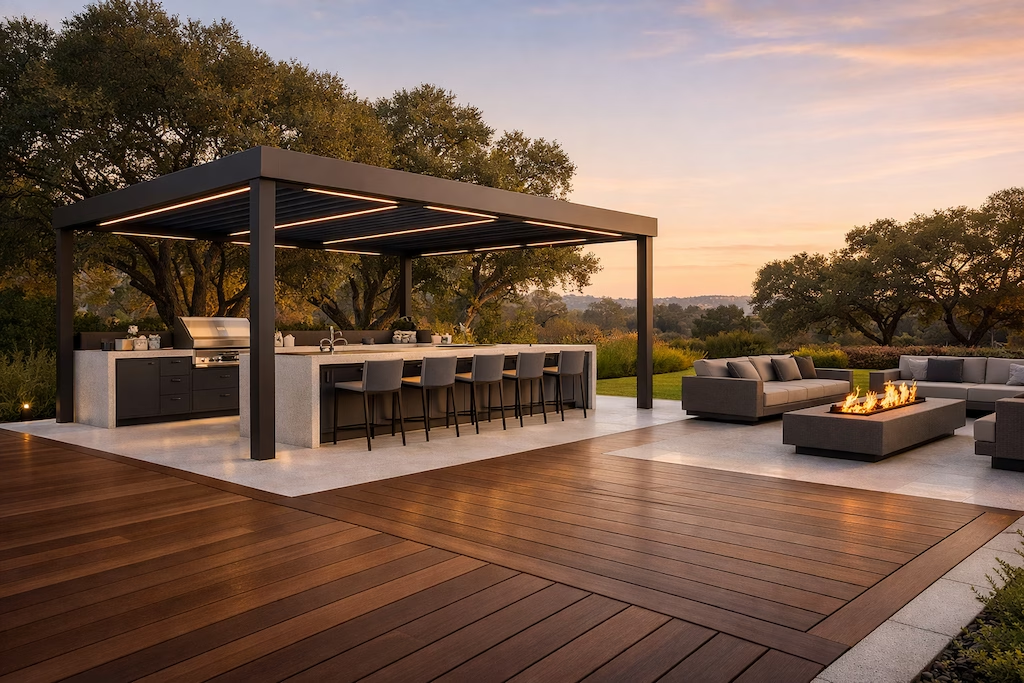
- $50k and up: Premium primary entertaining deck, advanced composite or exotic hardwood (Ipe), engineered footings, hidden fasteners, and integrated LED stair lighting.
- $95k and up: Elevated or multi-level systems, custom glass or cable railing, integrated dry-space drainage below the deck, and dedicated utility lines for heating.
- $150k and up: Hillside cantilever structures, deep caisson engineering, structural steel framing, and integration with a covered pavilion or outdoor kitchen.
- Biggest Cost Drivers: Elevation height, structural spans, decking material (Ipe vs. composite), custom railings, and complex hillside permit approvals.
- The Sequoia Difference: We manage the entire CSLB-compliant build, from deep hillside excavation and ledger flashing to final structural sign-off.
Costs: Structural Deck Programs (2026)
You cannot price a Peninsula deck strictly by the square foot of the surface boards. The true investment is dictated by the concrete footings, the thickness of the pressure-treated framing, the height of the elevation, and the architectural railing systems required by the city building code.
| Program Level | Typical Planning Range | Core Scope Included |
| Premium Entertaining Deck | $50k and up | Low-elevation primary space, premium composite or exotic hardwood (Ipe), engineered footings, hidden fasteners, and structural perimeter fascia. |
| Elevated Multi-Level System | $95k and up | Significant elevation requiring deep structural posts, custom stairs, architectural glass or cable railings, and under-deck dry-space drainage systems. |
| Estate Structural Cantilever | $150k and up | Large hillside footprint requiring deep caisson drilling, steel beam framing, integration with covered pavilions, and rigorous geotechnical engineering. |
Cost Adders: What Escalates Deck Budgets
These specific variables dictate the complexity of the engineering and dramatically shift the project timeline.
| Critical Adder | Why It Increases Cost | Where It Goes Wrong |
| Elevation & Hillside Engineering | Building over a steep slope requires deeply drilled concrete caissons and structural framing to meet California seismic codes. | Under-sizing the footings or using standard 4×4 posts, leading to extreme structural sway. |
| Railing Architecture | Custom frameless glass or marine-grade stainless steel cable railings are highly expensive structural elements, not just decorative borders. | Failing to install the necessary blocking in the frame, causing the heavy railings to wobble and fail code inspection. |
| Exotic Hardwoods (Ipe) | Ipe and Mahogany are incredibly dense, requiring specialized saw blades, pre-drilling every single hole, and highly skilled carpentry. | Treating Ipe like cheap pine, resulting in splintered cuts, stripped screws, and ruined material. |
Spec Tiers: How Estate Decks Prevent Failure
The internal engineering of your framing, ledger connection, and drainage determines if your deck lasts a lifetime or rots the side of your house in five years.
| System Element | Common Approach | The Sequoia Spec |
| Ledger Connection | Bolted over existing siding with minimal caulking, inviting water intrusion and dry rot into the home’s walls. | Siding removed, continuous Z-flashing installed, and structural lag bolts tied directly into the home’s rim joist. |
| Structural Framing | Joists spaced at 24 inches on center, creating a bouncy, springy, cheap-feeling deck surface. | Heavy pressure-treated joists spaced strictly at 12 to 16 inches on center for absolute rigidity. Joist tape applied to prevent rot. |
| Material Fastening | Screws driven directly through the top of the boards, creating hundreds of visible, ugly holes. | 100% hidden fastener systems. The surface of the deck remains perfectly smooth and unblemished. |
Drainage & Utilities Operational Flow
If you plan to utilize the space underneath an elevated deck, or run utilities for lighting and heating, it must be planned before the framing begins.
Pro Tip: The Trench Once Strategy
- Under-Deck Drainage: We install rigid EPDM catch-systems between the joists to capture rainwater and route it to a gutter, creating a completely dry, usable living space underneath the deck.
- Electrical Routing: Dedicated circuits for flush-mount stair lighting and high-voltage patio heaters are drilled safely through the joists before the decking is applied.
- Gas: Fire table gas lines are hard-piped into the framing layout, keeping the surface perfectly clear of hoses.
Permits, Seismic Codes, and HOA Realities
On the Peninsula, decks are subjected to some of the most rigorous building codes in the world due to seismic activity and fire risks.
Common 2026 Permit Triggers: Any deck over 30 inches off the ground, any structure attached directly to the home (ledger board), or any deck that exceeds specific square footage requires full engineering and a city building permit. Furthermore, jurisdictions bordering the wildland-urban interface (WUI), such as Woodside and Portola Valley, mandate specific fire-rated decking materials and enclosed framing to prevent ember intrusion.
Sequoia Outdoor manages this entire regulatory process. We ensure the structural engineering passes city review and navigate the HOA architectural boards on your behalf.
Protect Your Estate: Sequoia’s Due Diligence Advantage
Most contractors rely on beautiful composite samples to distract from their lack of structural expertise. We built Sequoia to provide absolute operational safety and transparency.
What to Ask Any Contractor, Including Us
- Excess Liability Insurance: We carry a $5,000,000 umbrella policy above our general liability coverage, above the $2,000,000 general liability limit.
- Documented Subsurface Proof: Our Project Managers capture mandatory photo and video proof of the deep concrete caissons, joist spacing, and ledger flashing before the decking is installed.
- The On-Time Guarantee: We put a written completion guarantee in the contract. If our internal scheduling causes a delay, we provide financial compensation.
Timeline: Structural Engineering & Scheduling
- Design & Engineering: 2 to 8 weeks depending on elevation complexity and custom railing fabrication.
- City Permits & HOA Approvals: 4 to 12+ weeks based on specific jurisdiction review cycles and seismic engineering approvals.
- Construction Execution: 4 to 12+ weeks. The process accelerates once the heavy footings are poured and the structural framing is complete.
Quote Checklist: Comparing Decking Bids
If the framing dimensions and ledger details are not written into the proposal, you cannot tell which structure you are buying, and nothing in the contract obliges the heavier one.
| Contract Item | What to Demand in Writing | The Red Flag |
| Ledger Flashing | Explicit callouts for Z-flashing and waterproof membranes where the deck meets the house. | No mention of how the home’s siding will be protected from water intrusion. |
| Joist Spacing & Tape | Demand 12 to 16-inch on-center joist spacing and the use of waterproof joist tape. | Framing details left completely undefined or vague. |
| Permits & Approvals | Clear legal language dictating who handles the city permitting and structural engineering. | The contract explicitly states the homeowner is responsible for all permits. |
Qualifying Questions (Speeds Up Your Estimate)
- City & Neighborhood: Atherton, Hillsborough, Portola Valley, Woodside, Menlo Park, Palo Alto, Los Altos Hills, Saratoga, Monte Sereno, Los Gatos.
- Scope: Elevation height, material preference (Ipe vs. Composite), custom railings, integrated lighting, dry-space drainage.
- Timeline: Ideal start date and any strict deadlines.
- Project Budget Range: $50k and up.
- HOA: Yes or no, and known property line constraints.
Frequently Asked Questions
What is Sequoia’s minimum project size?
Our minimum engagement is $25,000. We design and build permanent, engineered decks as part of comprehensive outdoor living programs. We do not provide basic board replacements or minor repair work.
Does the On-Time Guarantee apply to hillside decks?
Yes. Our On-Time Guarantee applies to all comprehensive design-build contracts. We account for complex hillside excavation and permit cycles during the planning phase to lock in a confirmed timeline.
Do I need permits for a deck on the Peninsula?
Almost always. Elevated structures, ledger board attachments, and heavy structural footings trigger strict city reviews for seismic safety and fire codes. We manage this entire process.
How long does an architectural deck take to build?
The engineering and permit approval phase requires several weeks. Once the permit is pulled, the heavy trenching for footings and the structural framing dictate the pace of the installation.
Service Area (Peninsula Focus)
We serve San Mateo and Santa Clara Counties, heavily focused on navigating the strict regulations of ultra-affluent pockets.
San Mateo County: Atherton (94027), Hillsborough (94010, 94062), Portola Valley (94028), Menlo Park (94025), San Carlos (94070), Woodside, and Emerald Hills.
Santa Clara County: Los Altos Hills (94022, 94024), Los Altos (94022, 94024), Saratoga (95070), Monte Sereno (95030), Palo Alto (94301, 94304, 94306), Cupertino (95014), Los Gatos (95030, 95032).
Secure Your Estate With Engineered Precision
We plan the entire system first: structural wind loads, roof drainage, utility routing, and CSLB-compliant scope documentation. Then we execute with real-time milestone tracking and a contracted completion date, set after the pre-construction walkthrough.