
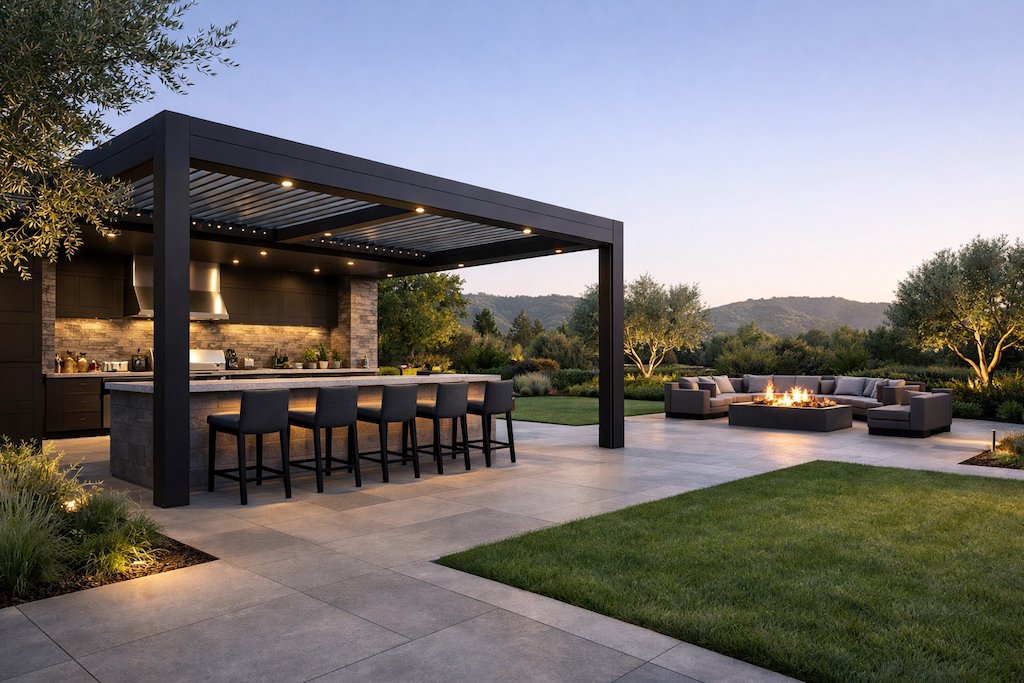


Project Fit & Investment Tiers
Sequoia Outdoor specializes in comprehensive, engineered outdoor environments for Peninsula estates. We build permanent, permitted architectural extensions of the home. We do not provide canvas shade installations or minor remodels.
- Minimum Project Engagement: $75,000
- Typical Elite Programs: $120,000 to $300,000
- Estate-Scale Master Plans: $300,000 to $500,000+
- On-Time Guarantee: Applies to all comprehensive design-build contracts.
An outdoor room is the apex of landscape construction. It requires merging the foundation requirements of a structural pavilion, the heavy electrical and gas loads of an outdoor kitchen, and the Title 24 energy compliance of a primary residence. In jurisdictions like Portola Valley and Los Altos Hills, building a fully enclosed or screened outdoor room also triggers the rigorous new 2025 California WUI (Wildland-Urban Interface) Code, which mandates strict fire-resistant building materials to prevent ember intrusion. This 2026 guide reveals the true costs of engineering a flawless, code-compliant outdoor living space that serves as a permanent extension of your home.
Educational only (not engineering advice). Every site is unique. Always verify structural requirements with a licensed civil engineer and your local Authority Having Jurisdiction (AHJ).
TL;DR: Peninsula Outdoor Room Costs (2026)
- $75k to $120k: Standard outdoor room featuring a solid roof or premium louvered system, fixed masonry or framed walls, and integrated heating and lighting.
- $120k to $180k (Most Common): Complete living environment with an integrated custom outdoor kitchen, dedicated A/V and electrical sub-panels, and motorized retractable screens.
- $180k to $350k+: Massive architectural extensions featuring full climate control, seamless floor-to-ceiling glass systems, multi-zone structural engineering, and intense WUI Code compliance.
- Biggest Cost Drivers: Wall/screen systems (glass vs. motorized mesh), roof architecture, heavy utility trenching, and stringent local permitting and ARB reviews.
- The Sequoia Difference: We possess a Class A General Engineering license, allowing us to legally manage the complex trenching, massive footings, and multi-trade coordination required for these builds.
Costs: Integrated Outdoor Room Programs (2026)
An outdoor room is priced like a home addition, not a landscaping project. The investment is driven by the structural capacity of the roof to carry heavy loads, the complexity of the wall enclosures, and the distance required to trench heavy-gauge utilities from the main house.
| Program Level | Typical Planning Range | Core Scope Included |
| Premium Enclosed Living | $75k to $120k | Solid roof structure or automated louvered system, fixed structural walls or half-walls for wind protection, and dedicated utility lines for heating and AV. |
| Integrated Culinary Room | $120k to $180k | Full integration of a custom outdoor kitchen and massive stone fireplace, requiring high-capacity gas trenching and motorized retractable bug/sun screens. |
| Architectural Estate Wing | $180k to $350k+ | Completely climate-controlled environments featuring frameless glass folding doors, structural steel framing, and rigorous Title 24 energy compliance engineering. |
Cost Adders: What Escalates Room Budgets
These features transform a basic pavilion into a true four-season extension of your home.
| Critical Adder | Why It Increases Cost | The Common Competitor Mistake |
| Wall & Enclosure Systems | Motorized retractable screens require perfectly square, structural headers to operate smoothly. Glass folding doors require massive steel support beams. | Framing the roof with standard lumber that bows over time, causing expensive retractable screens to jam and break. |
| Heavy Utility Trenching | Running water, a dedicated sewer lateral, high-capacity gas, and a 100-amp electrical sub-panel from the main house to the new structure is a major civil works project. | Under-sizing the gas line, resulting in the outdoor kitchen and overhead heaters failing when turned on simultaneously. |
| Roof Architecture | A solid, insulated roof requires complex drainage tie-ins, while a premium automated louvered system requires specialized motors and sensors. | Failing to design a proper slope for the roof, allowing water to pool and eventually leak into the finished ceiling. |
Spec Tiers: How Estate Rooms Are Actually Built
The foundation, drainage, and structural framing dictate if your outdoor room provides decades of comfort or becomes an expensive, leaking nightmare.
| System Element | Standard Contractor Baseline | The Sequoia Estate-Grade Spec |
| Base & Foundation | A standard 4-inch patio slab poured over uncompacted dirt. | Deeply excavated structural footings with heavy rebar cages, engineered to support massive roof and wind loads. |
| Hardscape Drainage | Basic surface slope hoping water rolls out the front of the structure. | Linear slot drains installed exactly at the threshold of the room, capturing all blowing rain before it enters the living space. |
| Structural Framing | Basic lumber prone to warping and twisting in the elements. | Heavy timber, structural steel, or extruded aluminum frames designed for zero deflection over large spans. |
Drainage & Utilities Operational Flow
An outdoor room is a hub of competing utilities. If gas, water, electrical, and structural drainage are not meticulously planned before construction begins, you will be tearing up finished masonry to fix them.
Pro Tip: The Trench Once Strategy
- Roof Drainage: Downspouts and internal post drains must be tied directly into a subsurface PVC pipe before the floor is poured.
- Power: Dedicated circuits for high-draw infrared heaters and motorized screens are mapped and trenched to a new sub-panel.
- Plumbing: If the room includes an outdoor kitchen sink, a pressurized water line and a code-compliant sewer lateral tie-in must be established early.
Permits, WUI Codes, and HOA Realities
California possesses the most rigorous building codes in the nation. Building a structural outdoor room is legally equivalent to building a home addition.
Common 2026 Permit Triggers: Pouring heavy footings, running electrical sub-panels, and attaching a roof structure to an existing home will always trigger intense city review. Furthermore, the standalone 2025 California WUI (Wildland-Urban Interface) Code now mandates strict fire-resistant framing and screening materials for any structure built in a designated Fire Hazard Severity Zone. Fully enclosed, conditioned rooms will also trigger Title 24 energy compliance.
Sequoia Outdoor manages this entire regulatory process. We ensure the civil and electrical engineering passes city review and navigate the complex HOA architectural boards on your behalf.
Protect Your Estate: Sequoia’s Due Diligence Advantage
Most contractors rely on flashy renderings to distract from their lack of structural expertise. We built Sequoia to provide absolute operational safety and transparency.
The Elite Vetting Checklist: What You Must Demand
- Debt-Free Operations: Financial instability destroys projects. Sequoia is 100% debt-free. Your deposit is strictly allocated to your property.
- Excess Liability Insurance: We maintain a $5,000,000 Umbrella Policy to protect high-net-worth assets from catastrophic construction incidents.
- Documented Subsurface Proof: Our Project Managers capture mandatory photo and video proof of the footing depth, rebar grids, utility trenching, and drainage slope before anything is covered up.
- The On-Time Guarantee: We are the only firm with a written completion guarantee. If our internal scheduling causes a delay, we provide financial compensation.
Timeline: Architectural Room Scheduling
- Design & Utility Definition: 2 to 10 weeks depending on architectural complexity, glass/screen integration, and material selection.
- Engineering and Permits: 4 to 14+ weeks as city inspectors review the structural wind loads, WUI compliance, and property line setbacks.
- Construction: 4 to 16+ weeks of active installation, heavily dependent on the depth of utility trenching and custom material lead times.
Quote Checklist: Comparing Structural Bids
If the internal structure and utility sizing are not explicitly detailed in the contract, you are guaranteed to receive an underperforming, settling structure.
| Contract Item | What to Demand in Writing | The Red Flag |
| Footing & Structure | Explicit callouts for engineered concrete footings and structural headers for screens. | Building a heavy roof on standard 4×4 posts bolted to existing thin pavers. |
| Utility Engineering | Detailed conduit routing plans and total electrical/gas load calculations. | Treating utility runs as an allowance to figure out later. |
| Permits & Approvals | Clear legal language dictating who handles the city permitting, Title 24, and inspections. | The contract explicitly states the homeowner is responsible for all structural permits. |
Qualifying Questions (Speeds Up Your Estimate)
- City & Neighborhood: Atherton, Hillsborough, Portola Valley, Woodside, Menlo Park, Palo Alto, Los Altos Hills, Saratoga, Monte Sereno, Los Gatos.
- Scope: Roof style, motorized screens, glass enclosures, integrated kitchen/fireplace, utility routing.
- Timeline: Ideal start date and any strict deadlines.
- Project Budget Range: $75k to $120k, $120k to $180k, $180k to $350k+.
- HOA: Yes or no, and known property line setbacks or WUI restrictions.
Frequently Asked Questions
What is Sequoia’s minimum project size?
Our minimum engagement is $50,000, though full outdoor rooms typically start at $75,000. We design and build permanent, architectural rooms as part of comprehensive outdoor living programs. We do not perform minor utility repairs or install temporary canvas structures.
Does the On-Time Guarantee apply to complex outdoor rooms?
Yes. Our On-Time Guarantee applies to all comprehensive design-build contracts. We account for custom screen/glass lead times and complex structural permit cycles during the planning phase to lock in a confirmed timeline.
Do I need permits for an outdoor room on the Peninsula?
Always. Pouring heavy footings, building walls, running heavy utilities, and tying into the main house trigger rigorous city safety reviews for wind load, seismic stability, and WUI compliance. We manage this process completely.
How long does a custom outdoor room take to build?
The engineering and permit approval phase requires several weeks. Once the permit is pulled, the heavy trenching for utilities and the pouring of the foundation dictate the pace of the framing and finish construction.
Service Area (Peninsula Focus)
We serve San Mateo and Santa Clara Counties, heavily focused on navigating the strict regulations of ultra-affluent pockets.
San Mateo County (Priority Clusters): Atherton (94027), Hillsborough (94010, 94062), Portola Valley (94028), Menlo Park (94025), San Carlos (94070), Woodside, and Emerald Hills.
Santa Clara County (Priority Clusters): Los Altos Hills (94022, 94024), Los Altos (94022, 94024), Saratoga (95070), Monte Sereno (95030), Palo Alto (94301, 94304, 94306), Cupertino (95014), Los Gatos (95030, 95032).
Secure Your Estate With Engineered Precision
We plan the entire system first: structural footings, heavy utility trenching, WUI Code compliance, and flawless architectural execution. Then we execute with real-time milestone tracking and a guaranteed completion date.