
On-Time or You Get Paid. (650) 844-2388 See guarantee terms


Homeowner’s guide · 2026 edition

The 33 questions most contractors hope you never ask.

Skipping due diligence is the most common reason these projects go sideways: delays, overruns, work you cannot inspect once it is buried, and a warranty from a company that is no longer solvent. Every question below is on this page in full, free, with what to ask each company for as proof. The printable scorecard, with blank columns to record what two other bids answered, is the download.

33Questions worth asking
5Where jobs go wrong
10Red flags
2Columns to score bids

Get the printable scorecard.

22 pages. Our answers are filled in. Yours to carry to every interview.

This field is for validation purposes and should be left unchanged.

We send the checklist and nothing else unless you ask. No call unless you request one.

CA Lic #1099847/A · C-27 · C-8 · D-06 · D-12/$2M GL · $5M umbrella/BBB A+
Cover of the Sequoia Outdoor Contractor Due Diligence Checklist, 2026 edition, for San Mateo and Santa Clara counties
22 pages · 5 sections · printable scorecard


The checklist · 33 items

Ask every company the same questions.

Our answers are in the right-hand column so you have a baseline to measure against. Ask the same questions of every other bid and write down what they say. Where a company cannot produce a document for its answer, treat the answer as a no.

01

How your project is run

7 items

Who is accountable, who is actually on site, and how you know what happened on the days you were not there.

Due diligence itemWhy it protects youSequoia’s answer
01Dedicated multi-layer support teamAsk for: Names and roles of every person assigned to your jobFive points of contact and oversight: your degreed Senior Designer, your Project Manager, our Lead Sr. Designer, our Sr. Office Manager and our General Manager. If one is unavailable, another steps in. Most companies assign one person, and the project pauses when they are busy.Yes, 5 contacts
02Formally trained designersAsk for: What your designer studied, and whereEvery Sr. Designer here holds a degree in Landscape Design or Landscape Architecture: site engineering and grading, soil science, plant communities, hardscape detailing, irrigation design and construction documents a crew can build from. At most companies the person designing your yard is a commissioned sales representative with no formal training in any of it.Yes, all degreed
03Dedicated project managerAsk for: Whether a PM is assigned, and what checklist they runA dedicated PM on every job, running a 100-point Quality Assurance Checklist that requires photo and video documentation at every critical stage before the project can move forward.Yes
04Documented subsurface installation proofAsk for: Photos of base prep, compaction, drainage and footingsThe most important structural elements of your project are buried. We document every critical subsurface phase with before, during and after photos and video: base prep, compaction, drainage, utilities, edge restraints and wall footings. If a problem arises later, there is a record of exactly what was installed.Yes
05Jobsite safety and compliance programAsk for: Their written safety programA structured program modeled on commercial construction standards: daily site walk-throughs, utility verification, trench and gas-line compliance checks and equipment safety protocols.Yes
06Daily documentation and progress trackingAsk for: How you will be told what happened each dayEvery day is logged with jobsite photos, notes and progress updates, so you know what was done, what is next and who was on site.Yes
07Live project tracking portalAsk for: Whether you get a login, or just a phone numberA live portal showing schedules, progress updates, photos, phase completions and upcoming milestones in real time. We have not found another contractor in Northern California offering clients one.Yes, exclusive
02

Scope, price and schedule

4 items

Exactly what you are buying, exactly what it costs and exactly when it will be finished, in writing, before work starts.

Due diligence itemWhy it protects youSequoia’s answer
08Detailed scopes and fixed pricingAsk for: A line-item scope with quantities, not allowancesLine-item scopes with fixed pricing: no vague allowances, no hidden line items, no surprise charges halfway through. The low quote that grows after signing is one of the oldest tactics in the trade, and a fixed line-item scope makes it impossible.Yes
09Written change order policyAsk for: The change order policy, in writing, before you signAny addition or adjustment is documented in writing with pricing confirmed before work proceeds. Vague or inflated change orders are among the most common ways a job climbs past its price.Yes
10Written schedule and timelineAsk for: A schedule with a start date and a completion dateA written schedule covering start date, duration of each scope item, major milestones and expected completion. Most contractors work without a real schedule, which is where delays and excuses come from.Yes
11Written on-time completion guaranteeAsk for: Whether missing the date costs them anythingIf we miss the agreed completion window, we compensate you until the project is finished. Both dates are set at your pre-construction walk, once permits, selections and locates clear, and written into your agreement. We have not found another company in San Mateo or Santa Clara County that puts this in writing.Yes, exclusive
03

Insurance and liability

6 items

Who pays when something goes wrong on your property. If the contractor is underinsured, the answer is usually you.

Due diligence itemWhy it protects youSequoia’s answer
12General liability insuranceAsk for: A current ACORD 25 certificate naming you as certificate holder$1,000,000 per occurrence and $2,000,000 general aggregate. Accidental property damage or injury on your job site is covered by our policy, not your homeowner’s insurance.$1M / $2M
13Umbrella / excess liabilityAsk for: Whether an umbrella policy exists at allA $5,000,000 umbrella sitting above the General Liability and Auto policies. Serious injuries, major property loss or multi-party incidents can exceed base limits quickly. Most residential contractors do not carry an umbrella.$5,000,000
14Workers’ compensation insuranceAsk for: A current workers’ comp certificateFull workers’ compensation, so that if anyone on the team is injured on your property their medical bills and lost wages are covered by our policy, not by you and not by your homeowner’s insurance.Yes
15Commercial auto liabilityAsk for: Whether coverage includes hired and non-owned vehicles$1,000,000 covering owned, hired and non-owned vehicles, so coverage follows any vehicle used for your project. Many contractors rely on personal auto policies, which leads to denied claims.$1,000,000
16Professional errors and omissions (E&O)Ask for: Whether design errors are insuredE&O protects you if there is a mistake in the design, planning or administrative side of your project, including legal defense. This coverage is uncommon in the industry and matters most on complex, design-driven projects.$1,000,000
17Subcontractor insurance certificatesAsk for: Certificates for every sub who will set foot on the propertyIf a subcontractor is uninsured, the liability can fall back on you even if they were at fault. We hold certificates for every subcontractor we use and provide them on request.Yes, all subs
04

Licensing and vetting

9 items

What the State of California has independently verified, and who is allowed onto your property.

Due diligence itemWhy it protects youSequoia’s answer
18CSLB license statusAsk for: The license number, then check it yourself at cslb.ca.govAn active CSLB license gives you four protections: verified competence, a bond that can compensate you if a contractor abandons a project, CSLB mediation and enforcement, and legal compliance. In California, hiring an unlicensed contractor for work over $500 is illegal and exposes you to liability for injuries, damages and unpaid wages.Active, #1099847
19Class A, general engineeringAsk for: Whether they hold A, or only C-27Class A covers fixed works requiring specialized engineering knowledge: the statute groups drainage, grading, earthmoving, excavation, trenching and paving alongside bridges and levees. Very few residential landscape companies hold it, because most are never asked to prove they can engineer below grade, which is precisely where these projects succeed or fail.Held
20C-27, landscapingAsk for: The classification that legally covers landscape constructionThe required CSLB classification for landscape construction in California: grading, drainage, irrigation, hardscape, planting and landscape construction.Held
21C-8, concreteAsk for: Who is licensed for the concrete scopeCovers forming, pouring, placing, finishing and installing concrete flatwork, slabs, pads and curbs. Concrete is permanent, structural and expensive to fix if it is done wrong.Held
22D-06, concrete-related servicesAsk for: Who is licensed for footings and structural padsCovers foundations, footings, slabs, pads and block work: the structural components that support the visible parts of an outdoor living space.Held
23D-12, synthetic productsAsk for: Who is licensed to install turfRequired for installing artificial turf and synthetic surfacing: base preparation, grading, drainage, seams, infill and edging, which is what determines whether turf drains and lasts.Held
24Subcontractors licensed for their tradeAsk for: License numbers for the electrical, gas, plumbing and grading subsCalifornia requires licensed professionals for grading, electrical, plumbing, gas and concrete. Using unlicensed subs exposes you to liability, voids warranties and fails inspections.Yes, all subs
25HIS license (sales representative)Ask for: The HIS number of whoever presents your contractIn California, any representative who meets with you, discusses your project or presents a contract must hold a valid Home Improvement Salesperson license. Working with an unlicensed salesperson is a violation of state law. Ask for the number.Yes
26Employee background checksAsk for: Whether the crew on your property was screenedFederal and state background checks on every employee before hire, verifying identity and reviewing criminal history.Federal and state
05

Track record and stability

7 items

Whether the company will still be standing, and solvent, when you need it to honor its word.

Due diligence itemWhy it protects youSequoia’s answer
27Founders’ proven operating systemAsk for: How long the system has been run, not just the entity ageSequoia was founded in 2022, and the operating system used to plan, manage and build was developed over 17+ years of production experience in California. What protects you is not how long a company has existed, it is the systems behind the work.17+ years
28Crew experienceAsk for: Who is actually installing, and for how longInstallation crews with 35+ years of combined hands-on experience in outdoor living construction: base prep, grading, drainage, compaction, edge restraints and precision layout.35+ years combined
29Completed installationsAsk for: How many builds, and how many were localMore than 150 outdoor living installations, nearly all inside San Mateo and Santa Clara counties, so the soil conditions, slopes and drainage patterns are already known rather than assumed.150+ local builds
30Third-party certificationsAsk for: Which independent bodies have certified themCMHA (Concrete Masonry & Hardscapes Association, formerly ICPI) is the industry’s leading certification for paver installation: base preparation, grading, compaction, edge restraints and jointing. BBB A+ reflects years of consistent, ethical business practice.CMHA and BBB A+
31Verified company reviewsAsk for: Direct links to review profiles, not screenshotsWe provide direct links to verified reviews. If a contractor cannot easily point you to verified reviews, or only shows cherry-picked screenshots, that is a red flag.5-star, verified
32Company financial healthAsk for: How they fund materials and payrollWe purchase materials upfront, pay crews weekly and do not rely on loans, credit float or vendor financing. Your deposit is used on your project, not to cover shortfalls on someone else’s job. Financial instability is what most often drives contractors to abandon projects, cut corners or disappear.A+, debt-free
33Installation warrantyAsk for: The warranty in writing, per scope, with the exclusionsWritten per scope of work rather than as one blanket number, with full terms in Exhibit A of your Home Improvement Contract. Some companies advertise 25 and 30-year warranties layered with exclusions that make them unusable. Specific terms you can read before you sign are worth more than a long number.2 years, by scope


Before you sign anything

Ten answers that should stop a conversation.

Each one has a direct cost, and it is almost always paid by the homeowner.
01No E&O, auto, or umbrella coverageMost carry only the minimum. The gaps land on you.
02Vague scopes or allowancesHidden cost traps.
03No documented subsurface workThe most important parts go unseen.
04No licensed subcontractorsIllegal and risky.
05No jobsite supervisionCrews left unsupervised cut corners.
06No dedicated project managerOne overloaded contact, not a support team. They send whoever is available.
07No written scheduleDelays and excuses.
08No financial stabilityContractors often use your deposit to finish someone else’s job.
09Sales reps, not trained designersUntrained in plants, materials, or drainage.
10No history of honoring warrantiesA warranty is worthless if the company will not be there to back it.
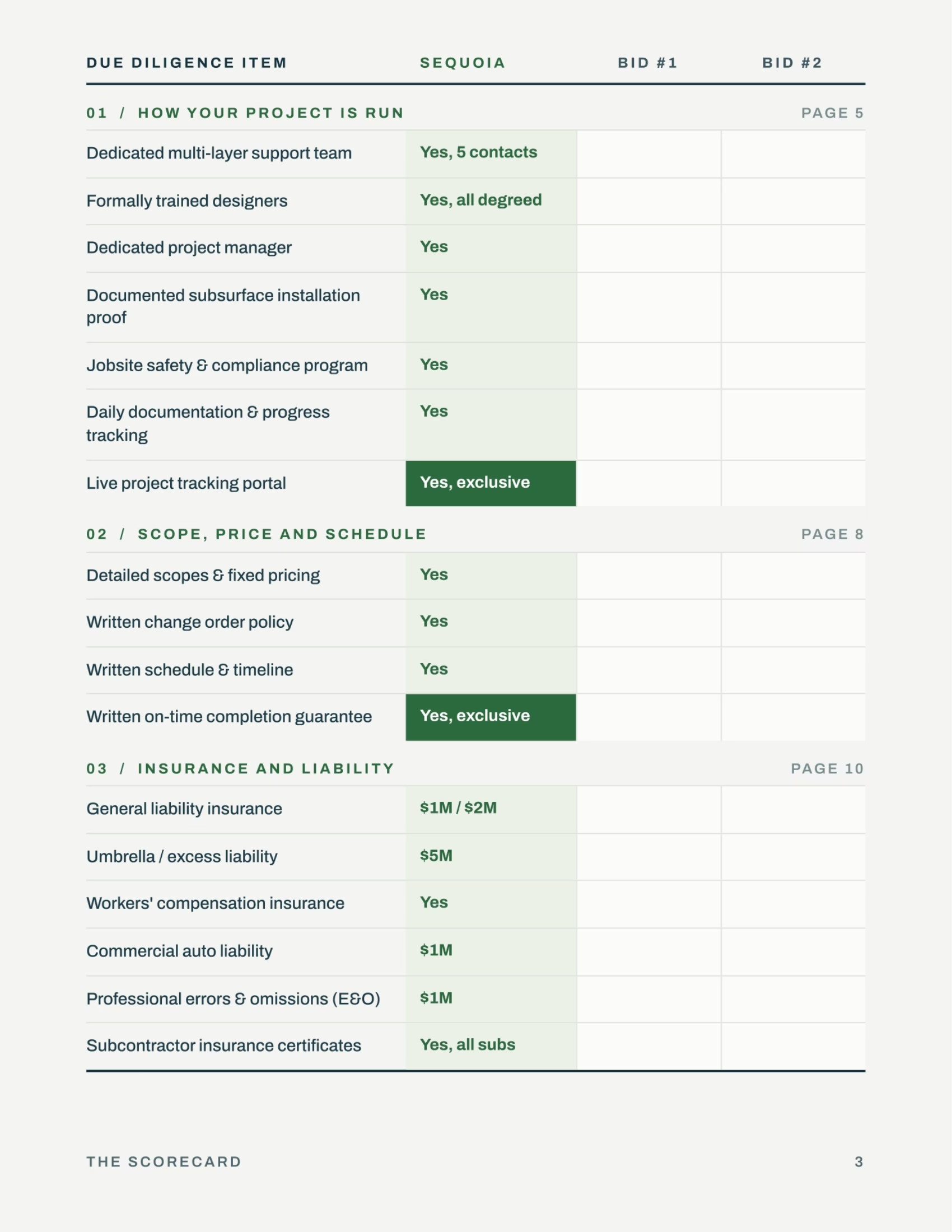
The scorecard page of the checklist, with Sequoia's answers filled in and two blank columns for scoring other bids
Page 3 · the scorecard

The download

Everything above, on paper, with room to score two other bids.

The page you are reading is the reference. The PDF is the tool: the same 33 items laid out as a scorecard with our answers pre-filled and two blank columns, plus the full explanation of every line, the ten red flags, and note pages for what each company said and what they could not show you.

Even if you do not choose us, use it with every contractor you interview. The wrong choice costs far more than the lowest bid saves.


Warranty, read properly

A long warranty is not the same as a good one.

Some companies advertise 25 and 30-year installation warranties layered with exclusions that make them unusable in practice, most often for settlement traced back to base preparation. Specific terms you can read before you sign are worth more than a long number.

Ours is written per scope of work rather than as one blanket figure, with the full terms in Exhibit A of your Home Improvement Contract. Coverage begins at the Certificate of Completion, extends to the original owner, and requires the project to be paid in full.

2 yearsInterlocking pavers, porcelain pavers, walls, drainage, lighting, turf
1 yearNatural stone, concrete, masonry, irrigation, pergolas, fire features, BBQ and appliances, decomposed granite
PlantingPlant health depends on watering and maintenance after installation, so planting is not covered by default. Coverage is available when purchased in writing.


Common questions

What homeowners ask us first.

What questions should I ask a landscape contractor before hiring them?

Ask for five things in writing before you sign anything: the CSLB license number and the classifications it covers for your scope; certificates for general liability, umbrella, commercial auto, workers’ compensation and professional errors and omissions; how base prep, compaction and drainage will be photographed before they are buried; the change order policy; and the warranty written per scope of work with its exclusions. A company that operates this way will have all five ready. The full 33-question version of this list is on this page, and the printable scorecard has blank columns so you can record what each bid answered.

What license does a landscape contractor need in California?

C-27 (Landscaping) is the classification California requires for landscape construction. Work that changes grade or moves water, such as drainage, grading, earthmoving, excavation and trenching, falls under Class A general engineering. Concrete flatwork falls under C-8, structural concrete such as footings and pads under D-06, and artificial turf under D-12. Hiring an unlicensed contractor for work over $500 is illegal in California and exposes the homeowner to liability for injuries, damages and unpaid wages. Any license number can be checked free at cslb.ca.gov.

What insurance should a landscape contractor carry?

General liability at $1,000,000 per occurrence and $2,000,000 aggregate is the baseline. Workers’ compensation is what keeps an injured crew member’s medical bills off your homeowner’s policy. Commercial auto should include hired and non-owned vehicles. Two more are less common and matter on larger projects: an umbrella or excess liability policy for claims that exceed base limits, and professional errors and omissions covering mistakes in the design itself. Ask for a current ACORD 25 certificate naming you as certificate holder, not a screenshot.

Why does documenting subsurface work matter?

Base preparation, compaction, drainage, utilities, edge restraints and wall footings are the structural elements of an outdoor project, and every one of them is buried before the job finishes. Once pavers or concrete go down, no inspection can tell you whether the base was built in lifts and compacted properly. Photo and video documentation at each stage is the only record that exists, and it is what settles the question if something settles, cracks or holds water years later.

Is a 25-year landscape warranty better than a 2-year warranty?

Not necessarily, and often the opposite. Long headline warranties in this trade are usually layered with exclusions that remove coverage for the failure modes that actually occur, particularly settlement traced to base preparation. What matters is whether the warranty is written per scope of work, whether you can read the exclusions before you sign, and whether the company is financially stable enough to still exist when you call. Ask to read the warranty exhibit itself rather than comparing the number on the brochure.

How do I check whether a contractor is financially stable?

Ask how they fund materials and payroll. A company that purchases materials upfront and pays crews weekly is not depending on your deposit to close a gap on another job. Ask whether they carry debt or rely on vendor financing, ask for a BBB rating, and be direct about what happens to your deposit between signing and delivery. Financial instability is the most common reason residential contractors abandon projects, cut corners or disappear mid-build.

Should the person who designs my landscape be a licensed salesperson?

In California, any representative who meets with you, discusses your project or presents a contract must hold a valid Home Improvement Salesperson (HIS) license, which is registered with the CSLB and requires a background check. That is separate from design training. Ask two questions: what is your HIS number, and what did the person drawing my plan study and where. At many companies the designer is a commissioned sales representative with no formal training in grading, soil science, hydrology or construction detailing.


However you choose

Use this with every company you interview.

Skipping due diligence is the leading cause of project delays, cost overruns, poor workmanship and contractor disputes on projects like these. The checklist is free and it works whoever you hire.

If you would like to see what these projects actually cost, our completed builds are published with itemized breakdowns from signed contracts, town by town.