
Custom Fountains + Recirculating Water Features
Custom Water Feature Builder, Peninsula & South Bay
Movement and sound, with the hidden system treated as the main event rather than an afterthought. We plan pondless fountains, urns, basalt columns and spillways with the reservoir, the pump, the utilities, the service access and the landscape around them.
CA Lic #1099847
/
$2M GL · $5M umbrella
/
On-time guarantee
/
BBB A+
Planning ballpark
From $8,000
Designed features start here and rise with type, size, reservoir, utilities and site.
Project minimum
$25,000
Completion date
In writing
Verified reviews
80 review listings and recommendations across six platforms as of 2026-08-30
What it costs
How much does a custom water feature cost?
A starting point you can plan against, and the reasons a tight range would mislead you.
Water features start around $8,000 and go up from there with little ceiling. The type, the dimensions, the reservoir, the pump, the waterproofing, the vessel or stone, the utility connections, the access and the landscape work around it all move the number, and a basalt column in a courtyard and a spillway built into a seat wall are not the same job in any respect except the word used to describe them.
For a sense of scale rather than a price: one documented Sequoia scope, two recirculating fountains with a spillway and an auto-fill on the San Bruno hillside backyard, ran $8,500 to $9,500 as a grouped line inside a complete backyard of $377,500 to $431,000. That is what that job cost. It is not what your feature costs, and we would rather show you a real one than a made-up average.
A ballpark you can plan against
A narrow band would look precise and mislead you. Water features vary more by type and site than almost anything else we build, so we give the starting point and the drivers and then price your actual design.
Name the parts, not just the feature
The feature, the reservoir, the pump, the plumbing, the electrical and water-source responsibilities, the finish materials, commissioning and the exclusions. A single number for “water feature” is not a proposal.
These are planning ballparks, not a rate card. Any figure shown for a completed project is what that specific job cost, on its own site, with its own access, selections and scope. Yours is priced from yours, and the written proposal is the only number that binds either of us.
Feature types
Which water feature fits your space?
Four different systems. The second paragraph on each card is the part that usually gets left out of the sales conversation.
Pondless or disappearing fountain
Water flows above the surface and returns to a concealed reservoir instead of an open pond. It suits courtyards, patio edges and smaller yards, and anyone who does not want open water in the design.
There is still water in the system. It sits in the reservoir under the gravel rather than on the surface, and it can go stagnant if circulation stops or debris blocks the intake.
- Reservoir capacity
- Pump-vault access
- Surface openings
- Splash containment
- Low-water protection
- Debris entering the hidden basin
Bubbling urn or basalt column
Water rises through a vessel or a drilled stone and returns to a concealed basin. Compact, and it works at entry courtyards and small patios where a pond would be out of scale.
Not every urn or column is quiet. The sound depends on the flow, the drop, the surface the water lands on and the acoustics around it, and it is adjustable within limits rather than fixed by the product.
- Vessel stability and anchorage
- Basin capacity
- Flow adjustment
- Mineral staining
- Splash radius
- Pump access
Spillway or water wall
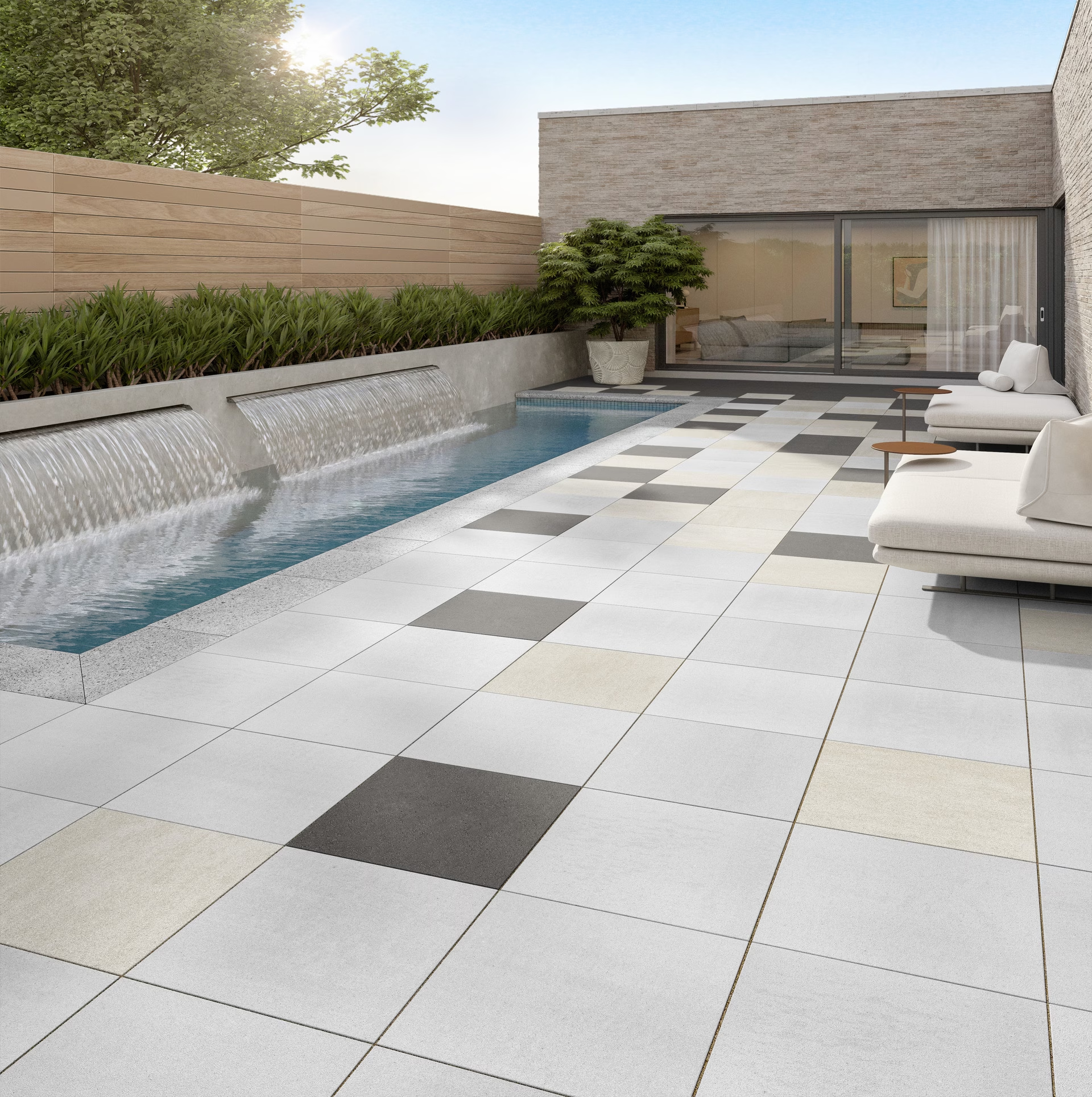
Water passes through a scupper or spillway and falls down a finished face or into a basin. It gives the strongest water sound of the four and suits contemporary patios and seat walls.
Structural design or engineering is provided where the wall, the feature, the site or the jurisdiction requires it. That is a per-project determination, not a property of the category.
- Waterproofing
- Wall penetrations
- Catch-basin dimensions
- Wind drift
- Splash and staining
- Overflow
- Access behind the wall
Open-basin fountain
A visible basin holds the recirculating water. It is the traditional choice for formal courtyards and larger focal points, and the only one of the four where the water is part of what you see.
Open water changes the review: access, evaporation, water quality, cleaning and any local barrier or permit requirement all apply differently than they do to a concealed reservoir.
- Child and pet access
- Mosquito prevention
- Evaporation
- Water quality
- Cleaning and overflow
- Basin drainage
- Local barrier requirements
Ponds and fish habitats are a separate discussion involving filtration, biological balance, oxygenation, fish care and ongoing service, and they are not what this page describes. Ask us directly if that is what you want.
Water use
Does a recirculating fountain use a lot of water?
It reuses what is in the system, and it still loses some. Here is where it goes and what the rules actually say.
A recirculating feature runs on the water already in it. It still loses water to evaporation, splash, wind drift and maintenance, and how much depends on the surface area, the flow, the exposure and how many hours a day it runs. We plan the catch area, the flow and the controls to keep avoidable loss down, and identify how replacement water will be monitored.
Surface area counts as high water use
California’s Model Water Efficient Landscape Ordinance defines a water feature as an area where open water performs an aesthetic or recreational function, and puts the surface area of water features in the high water use hydrozone of the landscape water budget. Areas irrigated with recycled water are treated as Special Landscape Areas. MWELO applies to new landscapes of 500 square feet or more, and rehabilitated landscapes of 2,500 square feet or more, where a permit, plan check or design review is required. Read the current text.
The drought fountain ban expired in 2023
You may still read that California prohibits refilling a fountain without a recirculating pump. That was the emergency regulation on wasteful water uses, and the State Water Board records that it expired on 21 December 2023, with no statewide emergency regulation currently in effect. Your local water supplier may have its own rules, which is the thing worth checking. Board status page.
Mosquitoes
Will a fountain attract mosquitoes?
A working feature is not a breeding site. A neglected one can be, and so can one that has been switched off.
Mosquitoes need standing or slow, stagnant water to reproduce. A recirculating feature that is running and maintained is a poor place for that. Circulation on its own is not a permanent guarantee: isolated pockets, a blocked intake, leaf litter in a hidden reservoir or a pump left off for a season can each change the answer.
San Mateo County Mosquito and Vector Control’s guidance for ponds, fountains and waterfalls is to run them so the water keeps moving, remove excess vegetation, and stock ponds with mosquitofish. That last one is advice for open ponds. A pondless reservoir is sealed under gravel and is not somewhere to put fish; keep it circulating and keep debris out of it instead. If a problem persists, the district will come and look at it. Their standing-water guidance.
If a feature is going to sit unused for a long period, the water left in it still needs managing rather than ignoring.
Safety
Are pondless water features safer for children?
A pondless design removes one specific hazard. It does not make a yard childproof, and we will not tell you that it does.
A pondless feature removes the permanent open pond found in a traditional water garden. Everything else still needs looking at on your property: surface openings, accessible water, wet stone underfoot, splash drainage, vessel stability and how the feature sits relative to the house and the places children actually play. Children need direct supervision around any accessible water, and depending on depth and design a building official may require additional safeguards.
Access, footing and openings
Routes from the house and from play areas, climbable objects beside open water, stable and secured vessels and columns, wet walking surfaces and where the splash drains to, and protection or restriction of the pump-vault opening.
A decorative fountain is not a splash pad
Decorative features are not designed or regulated for people to enter or play in, and they are a different thing from pools, spas and interactive water. We design the feature’s depth and classification deliberately, and we say when a pool, spa or interactive-water specialist is the right party instead of us.
Permits and trades
Does a water feature need permits?
It may. It depends on more variables than most people expect, and the honest answer needs the address.
Requirements depend on the city, the depth, any structural work, the electrical source, a permanent water connection, an auto-fill, drainage, lighting, and whether the feature could be classified as a pool, spa or interactive water element. We confirm the applicable approvals and the qualified-trade responsibilities before construction.
What can trigger a review
- A new electrical circuit or receptacle
- Pump, controls or underwater lighting
- A permanent potable-water connection
- Backflow prevention
- Auto-fill
- A structural or retaining wall
- Significant excavation
- An open pond, or pool-like depth
- A drain or overflow connection
- MWELO landscape documentation
- HOA or architectural review
California’s 2025 Building Standards Code took effect on 1 January 2026 and carries the current electrical, plumbing and building requirements. Verify against the Building Standards Commission and the local jurisdiction. San José, for example, states that structural, electrical and plumbing changes generally require the corresponding permit unless specifically exempted (their permit guidance). For how review runs in the design-review towns, see our Peninsula permits and HOA guide.
Sequoia holds California contractor classifications A (General Engineering), C-8 (Concrete), C-27 (Landscaping), D-06 and D-12, under license #1099847. We manage the overall landscape and water-feature scope and coordinate the qualified electrical, plumbing or specialty trade work the selected design requires. Each party’s work is named in the proposal. One accountable project team runs it from planning through sign-off, which is a different promise from claiming one crew performs every trade.
Maintenance
What does a water feature actually need?
Not much, regularly. The failure mode is neglect over a season, not a dramatic breakdown.
Every water feature needs periodic attention. A pondless design can need less water-surface maintenance than an open pond, which is not the same as being maintenance-free. What it takes depends on the design, the trees around it, the water hardness, the operating hours, the filtration and whether there are fish or plants in it.
Routine, and quick
Monitor the water level and the flow; Remove leaves and visible debris; Watch for abnormal splash or water loss; Keep the pump-vault access clear; Clean visible scale or biofilm with compatible products; Confirm the control schedule; Watch for mosquito activity when it is off.
Occasional, and worth doing
Clean the pump intake and impeller; Inspect the reservoir and vault; Check unions, valves and plumbing; Test the auto-fill and the shutoff; Inspect the overflow route; Check lighting and electrical components; Adjust flow and sound; Inspect waterproofing terminations; Drain and clean where required.
We hand over the manufacturer manuals for the equipment actually installed, so the operating and maintenance instructions you have are the ones for your system rather than a generic sheet.
Completed work
The documented water-feature scope
One published project, shown as what it is rather than padded out with unrelated work.
We have not photographed the fountains
The San Bruno fountains are built and the cost is documented, and we do not yet have a photograph that clearly shows them. Rather than put a patio picture here and let you assume, we have said so.
A grouped line, not a fountain each
Two fountains, the spillway and the auto-fill together, as one line inside a complete backyard. Ask any contractor to break a grouped figure into its parts before you compare it to anything.
How it runs
From sound concept to commissioned system
Six steps. Step five is the one that decides whether you ever have to open the stonework again.
Project-fit review
The full landscape scope, the feature you want, the budget, the service area and whether the project meets the minimum total engagement.
Placement and sound planning
Sightlines, seating, neighboring properties, wind, sun, trees, access, children and pets, and how much sound you actually want. More is not automatically better.
System and material selection
Feature type, dimensions, reservoir, pump, plumbing, waterproofing, water source, electrical source, controls, overflow and the finish materials.
Utility and permit coordination
Electrical, plumbing, backflow, structural, MWELO, HOA and jurisdiction requirements, confirmed before anything is built rather than discovered during it.
Construction and testing
The reservoir, waterproofing, plumbing and utilities are installed and tested before they are concealed behind stone, walls or finished surfaces. This order is not negotiable.
Commissioning and handoff
Final flow set, splash and overflow checked, controls and auto-fill tested, service access verified, and the operating and maintenance information handed over.
Completion terms are in writing: see the on-time completion guarantee and financing options.
Check your project fit
Review my water feature idea
Tell us the look, the sound and the maintenance level you want, and whether open water is acceptable on your property. We will review project fit, the likely scope and the best next step. Water features are built as part of qualifying landscape and outdoor-living projects starting at $25,000.
Questions
Straight answers, before you call.
How much does a custom water feature cost?
Our one published water-feature scope is two fountains with a spillway and an auto-fill in San Bruno at $8,500 to $9,500, as a grouped line inside a $377,500 to $431,000 project. A new feature depends on its type, dimensions, reservoir, pump, plumbing, utilities, waterproofing and finish materials, so we publish the one figure we can evidence rather than a range built on top of it.
Is there a project minimum?
Yes. Water features are built as part of qualifying landscape and outdoor-living projects with a $25,000 minimum total engagement.
What is a pondless water feature?
A feature that circulates water from a hidden reservoir through a fountain, urn, stone column, stream or waterfall, with the returning water passing through a covered surface into the underground basin. The water is still there. It is under the gravel rather than on view.
Is a pondless water feature child-safe?
It removes the permanent open pond found in a traditional water garden, and it is not childproof. Children need direct supervision around accessible water, wet surfaces and pump-vault openings, and the review is specific to your property rather than to the category.
Do water features use a lot of water?
A recirculating system reuses its operating water and still loses some to evaporation, splash, wind drift and maintenance. Surface area, wind, flow and operating hours drive how much. California’s landscape ordinance treats water-feature surface area as high water use in the landscape water budget.
Will it attract mosquitoes?
A running, maintained recirculating feature is a poor breeding site. An unused fountain, a blocked reservoir or an isolated pocket of standing water is a different matter. San Mateo County’s vector control district advises running fountains and waterfalls to keep the water moving and removing excess vegetation.
Does a water feature need an auto-fill?
Not always. An auto-fill maintains the operating level, and it needs a suitable water connection and can hide a leak while it does so. Where one is fitted, the design should include a shutoff and a way to notice abnormal water use.
How is the pump sized?
For the flow required at the system’s total dynamic head, accounting for vertical lift, pipe length and diameter, fittings, spillway width and the water effect you want. The headline gallons-per-hour figure on the box is measured at zero lift and is not what you will get.
Is a water feature difficult to maintain?
It varies with the design. Common tasks are topping off water, removing debris, cleaning the pump intake, managing scale or algae, and checking controls, plumbing and the overflow. A pondless design can need less water-surface maintenance than an open pond, which is not the same as needing none.
Can the feature run all day?
That depends on the pump, the system design, the sound, the energy use and how you want to manage mosquitoes. The operating schedule follows the equipment actually selected and your preference.
Can a fountain help cover traffic noise?
Moving water can reduce how much you notice some nearby sound. It will not remove traffic or neighborhood noise, and anyone promising that is overselling. Flow, drop height, position and the surfaces around it all change the result.
Can lights be added?
Yes, where the fixtures are listed for the intended wet location and are included in the electrical design. Underwater and in-fountain lighting needs additional electrical coordination and is not the same scope as landscape lighting nearby.
Do I need a permit?
Possibly. Electrical work, a permanent water connection, structural walls, an auto-fill, the feature’s depth and local landscape documentation requirements can each trigger a permit or a review. We confirm what applies to your address before construction.
Ready to plan your water feature?
Tell us the look, the sound and the maintenance level you want. We will confirm project fit, set a completion date in writing, and show you what each part of the work costs. Qualifying projects start at $25,000.